The knock came late in a long London day.
Vermon and his roommate had returned to their hotel with just enough time to rest before dinner and a West End show. They sat down on the bed for what felt like two seconds. Then they were asleep.
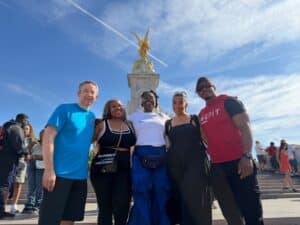
Pictured (left to right) Douglas Ireland, Chanel Diggs, Maria Johnson, Johanna Williams, Joe Houston Jr.
The day had begun with an early breakfast and a morning of service at The Felix Project, followed by an afternoon near the Docklands. Now Johanna Williams, Deputy Chief Operating Officer and one of the adult chaperones traveling with Martha’s Table’s Global Passport group, was knocking on the hotel room door. Vermon woke with a rush of adrenaline. The group had somewhere important to be.
At the Dominion Theatre that night, he settled into a seat along the middle aisle for The Devil Wears Prada. He hadn’t ever seen the film. He did not know the story. It meant that every turn arrived without warning, unfolding in front of him with the suspense of a first viewing. He was exhausted enough to drift, but the production would not let him.
“The play was way too good to fall asleep.”
Vermon
Then the performers in their elaborate dresses swept through the aisle beside him. The staging turned his seat into the center of the scene. Whatever fatigue remained disappeared.
“The dresses, they looked very nice,” he says, still delighted by the memory. “I really wish we could take a picture of this.”
Ask what Vermon expects to remember about London 10 years from now, and he returns to the musical. Live theater, immediate and impossible to pause, lodged itself firmly in his imagination.
For a young man who loves biking, musicals, roller coasters, video games, and the freedom of exploring somewhere new, it was the kind of moment that makes a distant city feel suddenly close.
Vermon is a member of Phelps ACE High School’s Class of 2025 and now studies criminal justice at the University of the District of Columbia. Born and raised in Washington, DC, he has always wanted to serve his community. When he describes himself, he chooses words that reveal both his ambition and his sense of responsibility: career-oriented, goal-oriented, logical, protective.
“I’m funny when people get to know me,” Vermon says. He tends to stay “in the shell” at first, watching how people act before revealing what he calls his “goofy side.”
That instinct shaped his first days at Martha’s Table. During his senior year at Phelps, an internship through Urban Alliance brought him to the organization after another planned placement changed. A friend he had known since middle school was already connected to Martha’s Table, so Vermon recognized an opportunity and asked to be placed there.
His introduction to the Teen Lounge came on his first day of work. The Teen Lounge was not yet open for its after-school hours, and he remembers using the space while helping repair small carts for the kitchen. Soon, he began returning during regular Teen Lounge hours.
At first, he mostly spoke to the friend he already knew. Vermon calls himself naturally shy. The room gave him time. Staff welcomed him. Familiarity accumulated. He met people he liked.
When asked what kept him coming back, his first answer is immediate: “The food.”
Then he laughs and widens the frame. He made friends there. It was somewhere to spend time, a place he could describe to another teenager without institutional language or a complicated pitch: “A cool place to hang out and chill.”
That simplicity is intentional. The Teen Lounge grew from listening to teens and families about the space they wanted. It welcomes teens ages 14 to 19 as they are, with room to rest, connect, create, learn, and lead. No-cost dinner and transportation assistance help ensure access and a sense of belonging.
In May 2026, the Teen Lounge marked its two-year anniversary, with more than 6,000 visits from nearly 500 teens. Vermon’s story shows how listening and investment become relationships: a young person arrives because of one friend, finds trusted adults and peers, then invites others through the same door.
“To me, it means coming somewhere where, no matter what, they will support you,” he says of Martha’s Table. “Whatever life achievements you have coming up, they will celebrate you. Everyone here is very supportive.”
Vermon learned about Global Passport through Martha’s Table’s youth development social media. The program invests in the curiosity, leadership, and potential that Ward 8 teens already carry through no-cost domestic and international experiential learning. Participants travel with Martha’s Table team members and adult ambassadors, combining exploration, service, reflection, and relationship-building.
The first trip that caught his attention was New York City. There would be a Broadway musical. For Vermon, already a fan of theater, that was enough to make the opportunity feel personal. The trip became his first chance to spend several days and nights in New York, rather than passing through on a shorter school visit. Later came Atlanta. Then London.
By the time he boarded the overnight flight from Dulles in August 2026, Vermon understood the rhythm of Global Passport travel. Before each departure, participants receive a detailed itinerary so they can anticipate what is ahead, giving them a structure sturdy enough to hold the uncertainty of a new place.
Still, London existed at a scale that was difficult to process.
“It didn’t feel real,” he says. “It still didn’t feel real when I was on the plane.”
He watched the small flight map move over the Atlantic, fell asleep, and woke up in another country. Even after landing, the distance felt abstract. Some things were familiar enough to orient him. Others announced themselves slowly.
The trains reminded him of Union Station, only “10 times bigger!” Streets were narrower. Buildings pressed closer together. Hospitals and emergency vehicles looked and sounded different. People seemed more reserved. To Vermon, London and Washington differed in nearly every visible system, from cars and rail networks to the height and arrangement of buildings.
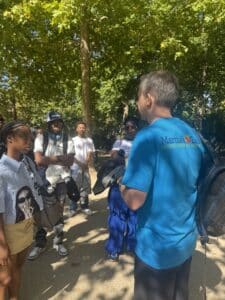
Douglas Ireland speaks with Vermon and other Global Passport teens during their walking tour.
He noticed the city at street level, which meant he noticed how much of it the group covered on foot.
“We did a lot of walking,” he says. “We need an emphasis on [packing] walking shoes.”
The itinerary moved quickly: the Tower of London, the British Museum, University College London, Buckingham Palace, Shakespeare’s Globe, Borough Market, and the London Eye. There was service at The Felix Project, a boat tour along the Thames, nightly reflections, and miles of sidewalks and Tube platforms in between.
For Vermon, an avid cyclist, London’s narrow roads and streams of fast-moving bikes triggered a different kind of daydream. He could imagine returning to experience the city on two wheels. Driving there held no appeal. Biking was another matter.
He had applied for the London trip partly because of the action film London Has Fallen, whose images of Big Ben, the London Eye, and Tower Bridge had made the city vivid long before he saw it for himself. Global Passport replaced the cinematic outline with texture: crowded stations, long walks, unfamiliar cues, a view from high above the Thames, and the ordinary work of learning how to move through a place that does not organize itself around what you already know.
Travel also changed the scale of Vermon’s social world.
He knew some of the teenagers on the London trip, but not all of them. His roommate was new to him and so were others who would become friends before the group returned to DC. The first couple of days carried the reserve Vermon brings into most unfamiliar rooms. Then, as he says happens on every trip, the shell began to open.
By the end of the trip, he says, he is talking to everybody.
He also became one of the group’s unofficial photographers. It was a fitting role for someone who prefers to observe before stepping forward. Behind the camera, attention becomes a form of participation. He could notice the scene, frame it, and give it back to the people experiencing it with him.
The itinerary made space each evening for reflection. Vermon watched the group grow more comfortable with each other. There were two birthdays during the trip, each marked with a small surprise celebration. When he was asked to choose three words for Global Passport, he landed on “adventure,” “community,” and “traveling.” The first and third describe movement. The second describes what made the movement matter.
That community did not require Vermon to become louder or less discerning about whom he trusts. It made room for him to enter unfamiliar spaces on his own terms. A roommate becomes a friend. Near-strangers build a collection of shared jokes, photographs, and memories. Vermon’s quiet observation becomes one of the ways he contributes to the group.
Vermon is clear about what the experience did and did not do. Global Passport expanded his world, but it did not create the strengths that carried him through it. His answer honors the person he already was.
“I wouldn’t really say a lot changed,” he says. “I was still myself then, still myself now. The only thing that changed was what I got to experience and who I got to experience it with.”
That distinction is the heart of his story. Travel did not invent his curiosity. His humor, discipline, ambition, and instinct to protect the people around him were already his. Martha’s Table invested in those strengths by creating access: a place to gather, adults ready to champion his next achievement, peers who could become friends, and opportunities to experience new places that matched the scale of his curiosity.
Back in Washington, Vermon returned with a jacket, a London hat, a small pillow, a constable bear, and a miniature passport from the LEGO Store. The souvenirs are playful evidence of a trip he once struggled to believe was real.
He also returned to college, work, and goals that predated his time in London. He wants to build stronger routines, ride more roller coasters, and keep moving towards his career. He imagines working in DC while living somewhere quieter. He wants to see Canada and visit the new Six Flags park in Saudi Arabia, home to a record-breaking roller coaster.
The list keeps growing because he now has evidence that faraway places can become real places. An application can become an itinerary. An itinerary can become a boarding pass. A screen image of the London Eye can become the view from inside it, paused at the top, while the city spins beneath him.
For another teenager considering the Teen Lounge or a future Global Passport trip, Vermon’s advice is direct. Do not let uncertainty make the decision for you. The program is intentionally designed so cost is not a barrier, with the trip, meals, and other essentials taken care of.
Bring clothes, he says. Bring curiosity. And absolutely bring the right shoes.
“To anyone who might be afraid of coming, it’s honestly a great experience,” Vermon says.
The world did not make Vermon brilliant. That brilliance was already his. The Global Passport experience simply gave him more room to move.
Learn more about how Martha’s Table partners with teens through the Teen Lounge, Barbers & Beauticians, and Global Passport program.

 News
News
0 New comments